In Defense of Crud: An Appreciation of Vintage Scholastic Paperbacks
I promise, this isn’t another clickbait essay raging against a certain new kid lit book I haven’t even read yet (still waiting for my library Hold) that supposedly classifies a large percentage of kids books as “crud”. I can somewhat understand the current backlash against Mac Barnett because, quoting my own work and the first essay I ever wrote for VQC about Margaret Wise Brown:
I should have told you at the beginning that you could skip this whole piece and just pick up Mac Barnett’s book “The Important Thing About Margaret Wise Brown”. At the 2020 WWU Children’s Literature Conference, he read the entire book out loud to us, the audience, and I’ve re-read it many times since and it’s perfect. Just perfect. I almost begrudge liking Mac Barnett, with his easy-breezy California charm but dang, he’s so good. I reiterate, TITAMWB is perfect. So go read it instead.
Begrudging admiration! I’ve seen writers officially condemning Barnett and demanding he step down, but this level of outrage is a little out of hand, given that MB is actually mostly right. If you’ve ever sorted book donations or browsed through a thrift store, you’ve seen the seedy underbelly of kids publishing: the product tie-ins, the cheap generic knock-offs and the Barnes and Nobles reprints of public domain works.
Yet it’s often the cheap and anonymous mass-market paperbacks from our youth that really stick in the sentimental folds of our brain and memories. I sell vintage kids books on Etsy, mostly to justify my thrifting habit, and Scholastic paperbacks from the 1960’s-80’s are my top sellers. It’s certainly not because they are beautiful objects; the cheap pulpy interior pages are always yellowed, the pages flutter free from the brittle glue binding like hairs shedding from my cat - but people purposely seek them out anyway.
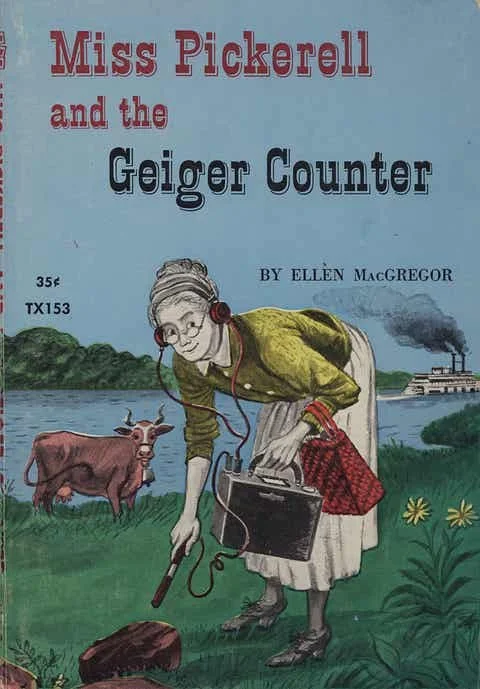
Arrow Flyer or a Scholastic Book Fair. For some deep nostalgia, check out this collection of 80’s Weekly Reader Order forms or this incredible round-up of 60’s-70’s Scholastic order forms and paperback covers. It’s clear that novelty joke books, pop culture tie-ins and posters were sold just as hard in the “good old days” when “kids actually read books” (I am quoting an imaginary grumpy old man here.)
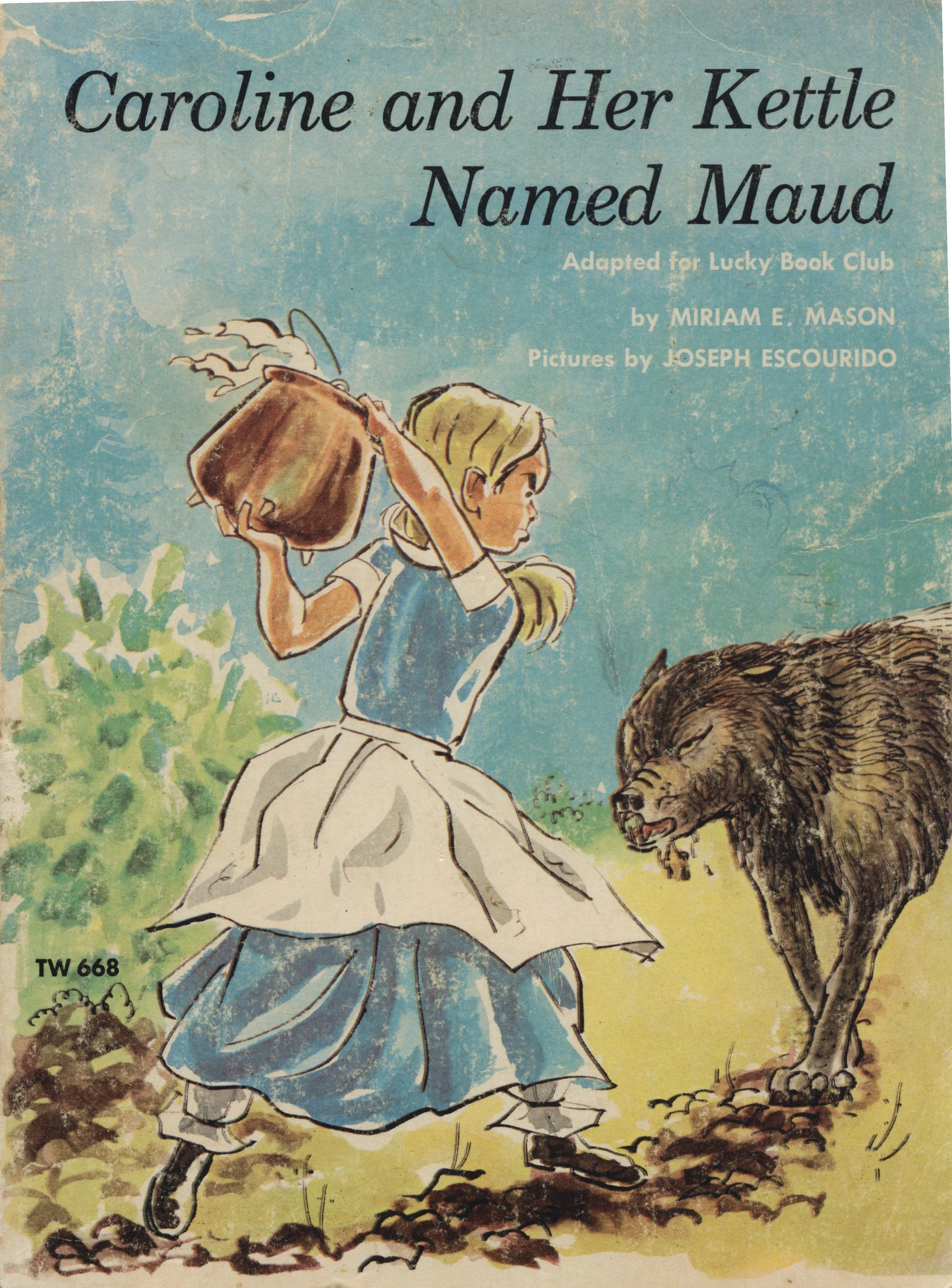
On my last day of second grade at New Sarepta Elementary, my teacher Mrs. Edwards handed me my report card and my first Scholastic paperback, a copy of Caroline and Her Kettle Named Maud. To this day, I could draw the cover from memory, and give you every detail of the story of a pioneer girl who faces down a wolverine with a kettle and not the gun she longs for. Yet by all standards it is not a “good” book. The author, Miriam E. Mason, seen here giving schoolmarm vibes:
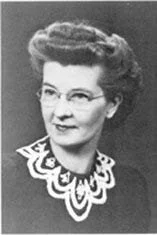
wrote mostly about Indiana where she was born and died (specifically Batesville, IN, home of the “globally recognized Batesville Casket Company”) through an early 20th Century Settler lens. She has over 70 books to her name with titles like Home is Fun, Susannah, the Pioneer Cow and Herman, the Brave Pig. But her words and thoughts live on in me through the gift of that Scholastic paperback.
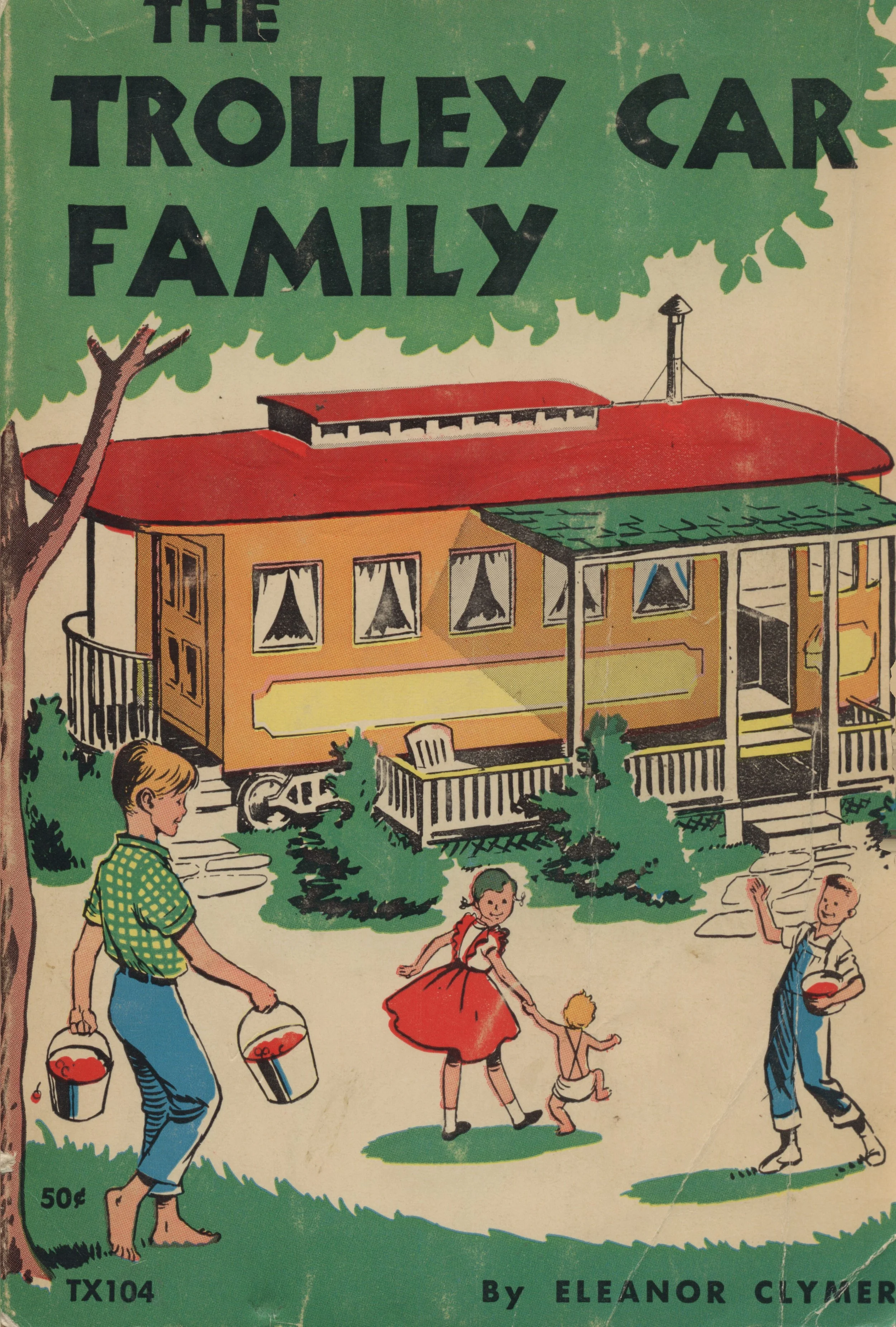
The Trolley Car Family by Eleanor Clymer 1 and 100 Pounds of Popcorn2 by Hazel Krantz were also Very Important Scholastic books to me, even though the authors were not well-known.
So was Just Plain Maggie about a summer at a girls camp. The author Lorraine Beim who had also teamed up with her husband Jerrold on Two is a Team, one of the first interracial picture books published in the US, died tragically young in a 1952 Mexico city car crash along with her daughter. Five years later, Jerrold and their 12-year old son Seth also died in a car crash, leaving Seth’s twin brother Andy the sole remaining Beim family member. There were whole universes I didn’t know behind these author’s names on the cover of the Scholastic books.
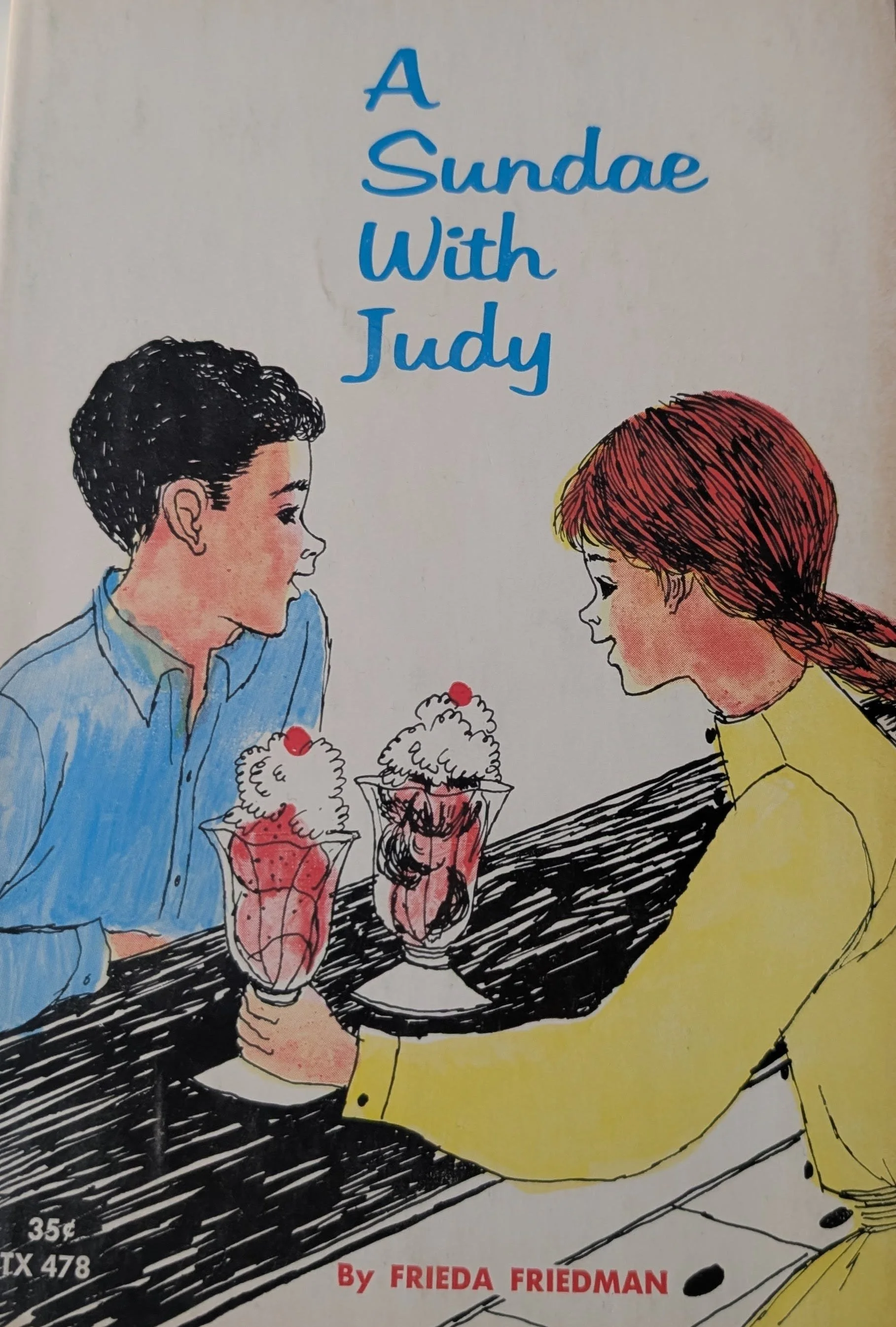
I missed A Sundae with Judy by Frieda Friedman as a kid, but picked it up last year at the thrifts because I liked the cover and the premise of living above her Dad’s candy store. Did I expect a 1949 mass-market paperback to have a sub-plot of Judy wrestling with discrimination and exclusion and confronting prejudice when she nominates her Chinese friend Mayling as a member of their Saturday club? I did not! Some of Judy’s friends straight out object to a Chinese girl joining and others want to just stop talking about it:
Judy couldn’t believe her ears. Had her friends really said, “it isn’t important enough” and “what difference does it make?” Why, to Judy it was very important and it made all the difference in the world. Judy felt she couldn’t remain a member of a club that wouldn’t admit a girl because her skin was a little darker than the other members and her eyes were shaped differently. The only fair thing was to meet Mayling and judge for themselves.
Not what you expected from a book with this cover, right?
Not to puff Frieda Friedman up TOO much, the very funny and sharp site Lost Classics of Teen Lit 1939-1989 had this take down of Friedman’s Carol:
While these are understandably difficult adjustments for any 11-year old, Ms. Friedman has created the single most unsympathetic YA heroine I have yet come across.
Lost Classics has quickly become one my favorite kids lit site, a positive treasure trove of hilarious and thorough considerations of teen romances and children’s literature from the past, highlighting books and authors that scholars aren’t necessarily paying attentions to but that - judging from the comments - had a big impact on kids, like from this post about Going on Sixteen by Betty Cavanna:
Jola says:
I want you to know how much I loved coming across this post. I still have my 1946 copy (published by The Westminster Press) that I read many, many times in the 1960s and 70s. I always pictured Julie with a certain look. In my young adult years, I came upon a hinged metal box, with a painting on the lid. It was a girl and a collie, running through a field of daisies. They looked just as I had imagined Julie and her beloved Sonny would look!
Imprinted! There’s something to be said for these (mostly) forgotten (mostly) women writers: teachers and housewives and artists practicing their craft by writing dozens of slim paperback novels that helped pay the bills, that were reliably published and ably illustrated, and reached millions of kids across the country via book fairs and paper flyers. Others like Beverly Cleary did it on a higher level and a slightly more distinguished platform and are remembered for their art but apparently kids don’t need just the highest rarefied air. Kid readers need all levels of writing - the wheat and the chaff, the masterpiece and the crud - because you never know what will stick with them years in the future, and have them searching the internet for a beat-up copy of memories.
Eleanor Clymer (1907-2001) published 58 books for kids and her son Adam Clymer grew up to be a prominent political correspondent for the NYT. His unflinching reporting on G.W. Bush made him unpopular with Republicans and infamously, in September 2000, Bush and Cheney were caught on a hot mic calling him “that major-league asshole from the NYT”, causing the kind of campaign controversy that seems downright quaint in 2026.
For a contemporary overview of (maybe the only business in the US to still be small and family owned) American Pop Corn Co which makes Jolly Time Popcorn and includes a mention of the 100 pound burlap sacks they used to distribute popcorn in, please do check out this fascinating Feb 24, 2019 article in Sioux City IA’s paper of record, The Messenger.